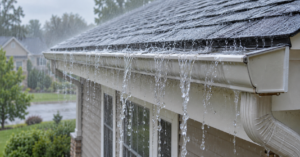
You check your gutters and they look clean, but water still pours over the sides whenever it rains. What is going on?
Gutters can overflow even when they are not clogged. The problem may be caused by incorrect gutter slope, undersized or poorly positioned downspouts, heavy roof runoff, gutters that cannot handle the amount of water coming from the roof, or installation and drainage problems.
This can be especially noticeable during heavy rain in New Jersey, when a large amount of water reaches the gutters in a short period of time.
If your gutters repeatedly overflow despite being clean, the issue may be with the way the gutter system is collecting, moving, or draining water.
Why Are My Gutters Overflowing If They Are Not Clogged?
A gutter system has a simple job: collect water from the roof and direct it safely through downspouts and away from the house.
When that process does not work correctly, water may spill over the front or back of the gutter.
Common causes include:
- Incorrect gutter slope
- Too few downspouts
- Downspouts that are too small
- Heavy roof runoff during storms
- Gutters that are undersized for the roof
- A partially blocked downspout
- Poor gutter installation
- Gutters pulling away from the house
- Poor drainage at the bottom of the downspout
- Roof sections that direct too much water into one small section of gutter
Finding the actual cause is important because simply cleaning the gutters will not fix an installation or drainage problem.
1. The Gutter Does Not Have the Correct Slope
Gutters need a slight slope so that water moves toward the downspouts. If a section of gutter is too level, water may sit inside instead of flowing efficiently toward the outlet. If the gutter has sagged or developed an incorrect slope over time, you may notice standing water after rain, overflow from one particular section, and water spilling near the middle of the gutter. You will also notice overflow occurring even when the gutter is clean and sections of gutter that appear to sag.
A gutter that has shifted slightly may still look normal from the ground, so the problem is not always obvious.
What can cause gutter slope problems?
Several things can change the original slope, including:
- Loose or damaged hangers
- Improper installation
- Weight from accumulated water
- Ice and snow
- Aging gutter sections
- Movement of the fascia
- Physical damage
If water consistently remains in one part of the gutter after rain, the slope should be checked.
2. The Downspout Cannot Handle the Amount of Water
Sometimes the gutter itself is working correctly, but the downspout cannot move water away quickly enough.
Think of the gutter as a collection channel and the downspout as the drainage pipe. If the downspout capacity is inadequate for the amount of water entering the system, water can back up and eventually overflow.
This can happen when:
- A large roof section drains into one downspout
- There are too few downspouts
- The downspout is undersized
- The downspout outlet is poorly positioned
- Several roof sections drain into one small area
You may notice that the gutter overflows primarily during heavy rain but appears to work normally during light rainfall.
That pattern can be an important clue.
3. Heavy Roof Runoff Is Overwhelming the Gutter
Your roof may be sending more water into the gutter than the system can handle during intense rainfall.
New Jersey storms can produce periods of heavy rain, and a large amount of water can reach the roof within a short time.
The water flows down the roof surface and into the gutters.
If the volume becomes greater than the gutter and downspout system can handle, water may spill over the edge even though there is no debris blocking the gutter.
This is one reason a gutter system that appears to work perfectly during light rain can overflow during a downpour.
4. The Gutters May Be Too Small for the Roof
Not every gutter system is appropriate for every roof.
The size and layout of the roof affect how much rainwater reaches the gutters.
A larger roof area can collect a substantial amount of rainwater. Roof pitch, drainage patterns, and the location of valleys can also affect where water enters the gutter system.
If the gutters were installed without properly considering the roof drainage pattern, you may experience repeated overflow.
This is particularly important around roof valleys.
Why are roof valleys a problem?
A roof valley concentrates water from two roof slopes into one area.
During heavy rain, that section can receive significantly more water than an ordinary section of gutter.
If the gutter below the valley is not designed to handle that concentrated flow, water can overshoot or overflow.
5. The Downspout May Be Partially Blocked
A gutter can be completely clean while the downspout is partially blocked.
Leaves, small pieces of debris, dirt, or other material can collect inside the vertical or underground portion of the drainage system.
A partial blockage may allow some water through but restrict the flow enough to cause overflow during heavy rain.
This can make the problem confusing.
You may clean the gutter and still see water spilling over because the actual restriction is farther down the system.
Signs of a downspout problem
Look for:
- Water backing up near the downspout
- Overflow around the downspout connection
- Very little water coming from the bottom during rain
- Water appearing around an underground drain outlet
- Overflow that becomes worse during heavier rainfall
If a downspout disappears into an underground drainage system, the blockage may be below ground and difficult to identify without proper inspection.
6. Poor Gutter Installation Can Cause Overflow
Sometimes the problem starts with the original installation.
A gutter system needs to work as a complete drainage system. The gutters, outlets, downspouts, hangers, roof drainage pattern, and discharge points all need to work together.
Installation problems can include:
- Incorrect gutter pitch
- Poorly positioned downspouts
- Too few downspouts
- Improperly installed gutter sections
- Inadequate support
- Poor connections
- Incorrect placement below roof edges
- Downspouts that discharge too close to the foundation
A system can look acceptable from the ground and still have drainage problems.
If overflow has been happening since the gutters were installed, installation or design should be considered as a possible cause.
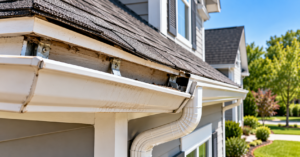
7. Your Gutters May Be Pulling Away From the House
Look at the front edge of your gutters from the ground.
Do they appear straight and firmly attached, or are some sections sagging or pulling away from the fascia?
Gutters that have separated from the house can develop drainage problems.
A section may become lower than intended, changing the direction in which water flows.
You may also see:
- Gaps between the gutter and fascia
- Sagging sections
- Water escaping behind the gutter
- Water overflowing from one low section
- Loose hangers
Overflow is not always caused by something inside the gutter. Sometimes the gutter itself has moved.
8. Water May Be Overshooting the Gutter
Another possibility is that water is not entering the gutter correctly.
This can happen around areas where a large amount of roof water is concentrated, particularly near valleys or certain roof transitions.
During heavy rainfall, water can move quickly down the roof and travel over the front edge of the gutter rather than entering it.
If you notice water consistently shooting over the gutter in one specific location, rather than simply filling the gutter and spilling over, the roof-to-gutter relationship should be inspected.
How Can I Tell What Is Causing My Gutter Overflow?
Pay attention to where the water is coming from.
Water overflowing from the middle of the gutter
This may indicate:
- Incorrect slope
- A sagging section
- Too much water entering that area
- Poor gutter positioning
Water overflowing near the downspout
Possible causes include:
- Restricted downspout
- Undersized downspout
- Too much water entering the system
- Poor connection between gutter and downspout
Water overflowing below a roof valley
This can indicate that a concentrated amount of roof runoff is overwhelming that section of the gutter system.
Water overflowing only during very heavy rain
This may point toward:
- High roof runoff
- Insufficient gutter capacity
- Insufficient downspout capacity
- Roof drainage design issues
Water flowing behind the gutter
This may indicate:
- Gutter separation
- Installation problems
- Fascia issues
- Incorrect positioning
- Water coming from the roof edge rather than properly entering the gutter
The location and timing of the overflow can provide useful clues.
What Can I Check Myself?
There are a few relatively simple observations you can make without climbing onto the roof.
Check the gutters from the ground
Look for:
- Sagging sections
- Loose sections
- Gutters pulling away from the house
- Visible gaps
- Obvious debris
- Water stains on the exterior
Watch the system during rain
If possible, observe the gutters from a safe location during rainfall.
Pay attention to:
- Where water first begins overflowing
- Whether overflow happens only during heavy rain
- Whether water reaches the downspout
- Whether water comes from behind the gutter
- Whether one section consistently has the problem
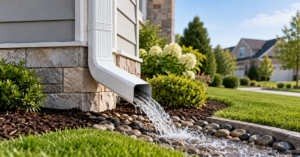
Check the downspout discharge
During rain, water should be able to exit the downspout.
If very little water comes out while the gutter above is filling with water, the downspout or drainage path may have a restriction.
Do not climb onto the roof or lean out of windows to inspect gutters. Roofing surfaces can be slippery, particularly when wet.
How Are Gutter Overflow Problems Fixed?
The correct solution depends on the cause.
A contractor may recommend one or more of the following:
Correcting the gutter slope
If the gutter has shifted or sagged, it may need to be repositioned and properly supported.
Adding or repositioning downspouts
If too much water is entering one section, an additional or better-positioned downspout may improve drainage.
Improving downspout capacity
In some situations, the drainage system may need appropriately sized components.
Repairing damaged gutter sections
Bent, separated, or badly sagging sections may need repair or replacement.
Clearing the downspout
If the downspout is restricted, removing the blockage can restore proper flow.
Improving the discharge point
Water needs to be carried far enough away from the house to reduce the risk of drainage problems around the foundation.
Reworking the gutter system
If the existing system was poorly designed for the roof, repairs to individual sections may not solve the underlying problem. A more comprehensive gutter or drainage solution may be appropriate.
Why New Jersey Weather Can Make Gutter Problems More Noticeable
Gutters need to handle changing weather conditions throughout the year.
Heavy rainfall can quickly increase roof runoff. Winter conditions can also place additional stress on exterior drainage components.
This means a gutter system that appears to work during normal rainfall may reveal weaknesses during a major storm.
For New Jersey homeowners, it is particularly important to pay attention to repeated overflow rather than treating every incident as a simple cleaning issue.
If the same section overflows every time it rains heavily, there may be an underlying drainage or installation problem.
Can Gutter Overflow Damage My Home?
Yes. Repeated uncontrolled water can contribute to problems around the roof edge, siding, exterior walls, and foundation area.
Depending on where the water is going, you may notice:
- Water stains
- Damaged landscaping
- Soil erosion
- Wet areas around the foundation
- Water running down exterior walls
- Damage around fascia or soffits
- Problems caused by water entering where it should not
The longer a drainage problem continues, the more important it becomes to identify where the water is actually going.
Should I Replace My Gutters If They Keep Overflowing?
Not necessarily.
Gutter replacement is only one possible solution.
If the gutters are in good physical condition, the problem may be caused by:
- Incorrect slope
- A blocked downspout
- Poor drainage
- Too few downspouts
- Roof runoff concentration
- Installation problems
Replacing perfectly usable gutters without addressing the underlying drainage issue may not solve the problem.
On the other hand, severely damaged, sagging, or poorly installed gutters may be better candidates for replacement.
The right approach is to identify the cause first.
When Should You Call a Professional?
Consider having the system inspected if:
- Your gutters overflow repeatedly
- Cleaning does not solve the problem
- One section always overflows
- Water is coming from behind the gutter
- Gutters are sagging or pulling away
- Downspouts appear to drain poorly
- Water is collecting near the foundation
- Overflow is causing visible exterior damage
- You cannot determine where the problem is coming from
A professional inspection can look at the gutter system together with the roof drainage pattern rather than treating the overflow as an isolated problem.
For homeowners dealing with roof, exterior, or drainage-related problems, it can also be helpful to inspect the surrounding roof and exterior areas for signs of water intrusion.
Frequently Asked Questions
Why are my gutters overflowing when they are clean?
Clean gutters can still overflow because of incorrect slope, inadequate downspouts, excessive roof runoff, undersized gutters, partially blocked downspouts, or installation problems.
Why do my gutters overflow only during heavy rain?
Heavy rain can send a much larger volume of water from the roof into the gutter system in a short period. If the gutter or downspout capacity is insufficient, water may overflow even though the system works during lighter rain.
Why does water overflow from the middle of my gutter?
Overflow from the middle can be related to an incorrect gutter slope, a sagging section, concentrated roof runoff, or a gutter that is not properly positioned.
Why does my gutter overflow near the downspout?
A restricted or undersized downspout can prevent water from leaving the gutter quickly enough. The connection or drainage system below the downspout may also have a problem.
Can gutters overflow if they are too small?
Yes. If the gutter system cannot handle the amount of water reaching it from the roof, water can spill over the edge during heavy rainfall.
Why is water coming over the front of my gutter?
Water can come over the front when the gutter fills faster than it can drain, when roof runoff is concentrated in one area, or when the gutter has an installation or slope problem.
Should gutters have standing water after rain?
Small amounts of residual water can occur, but significant or persistent standing water may indicate a drainage or slope problem. If one section repeatedly holds water, it is worth having the gutter system checked.
Can a gutter problem cause water near my foundation?
Yes. If downspouts do not carry water away effectively, rainwater can collect around the foundation area. The exact risk depends on the property’s grading, drainage system, soil, and how much water is being discharged.
Do I need new gutters if mine keep overflowing?
Not always. The cause should be identified first. Cleaning, repairing the slope, correcting downspouts, improving drainage, or addressing installation problems may solve the issue without replacing the entire system.
Final Thoughts
Gutter overflow is not always a clog problem.
If your gutters are clean but still overflow, look beyond the gutter itself. The real issue may be the slope, downspout capacity, roof runoff, gutter size, drainage path, or original installation.
The most useful clue is often where and when the water starts overflowing.
If the problem happens repeatedly, especially during heavy New Jersey rain, having the gutter and surrounding roof drainage system inspected can help identify the cause before continued water exposure creates larger exterior or drainage problems.
National Home Improvements can help homeowners evaluate roof and exterior problems that may be contributing to water-management issues. If your gutters are repeatedly overflowing and you cannot determine why, contact National Home Improvements to discuss the problem and determine whether an inspection or repair is appropriate.